IRS Publication 525 restricted stock units are taxed as ordinary wages at vest, and that same fair market value becomes your cost basis when you sell—otherwise Schedule D re-taxes dollars you already paid income tax on through Form W-2. Publication 525 frames RSU settlement as compensation, not investment income, which means your per-share basis equals the FMV your employer included in Box 1 wages on the settlement date. When your broker's Form 1099-B imports $0 or a partial number, the fix is a basis entry on Form 8949 column (e), not a dispute about sale proceeds.
Verified against IRS Publication 525 (2025) and Instructions for Form 8949, accessed 24 August 2026. As of the 2026 filing season, major brokers still file Form 1099-B with $0 or incomplete cost basis for standard RSU lots because they never received payroll wage data—this guide maps Pub. 525's wage rule to the cost-basis entries you make after the 1099-B arrives.
$0
default broker-reported cost basis on many RSU Form 1099-B imports
Brokers report purchase price, not Publication 525 wage inclusion—Form 8949 column (e) is where you enter vest FMV as cost basis
What Publication 525 says about RSU cost basis
IRS Publication 525 does not print a "cost basis" worksheet for RSUs, but its wage framework is the legal reason your basis exists. Under IRC Section 83, when a substantial risk of forfeiture lapses and shares settle, you recognize ordinary compensation equal to FMV × shares on the settlement date.
That wage event and your sale basis are the same economic number viewed from two systems:
| System | What it knows | What it reports | Cost basis on sale |
|---|---|---|---|
| Payroll (Pub. 525 wage rule) | Vest FMV at settlement | Form W-2 Box 1 | FMV becomes your tax basis |
| Brokerage (1099-B rules) | Cash you paid for shares | Form 1099-B Box 1e | $0 for standard RSUs |
| Taxpayer (Form 8949) | Both documents | Column (e) cost or other basis | Vest FMV × shares sold |
Form 1099-B instructions tell brokers to report cost or other basis as the amount paid for the security.1 You paid $0 when RSUs settled—you received shares as wages. The broker never saw the $47,400 (or whatever) your employer put on Form W-2. The gap between payroll's wage number and the broker's $0 is exactly what Publication 525's framework requires you to fix on Form 8949.
For the full Pub. 525 lifecycle (withholding, W-2 boxes, sell-to-cover), see IRS Publication 525 RSU Tax Guide: Taxed When Vested. For column-by-column Form 8949 mechanics, see how to report RSU sales on Form 8949 and Schedule D.
The three-document cost basis chain
Think of RSU cost basis as a three-document reconciliation, not a single-form fix:
Equity supplement (vest FMV) → Form W-2 Box 1 (wages) → Form 8949 column (e) (cost basis)
                                      ↑                           ↑
                              Publication 525 rule          Corrects Form 1099-B $0
Methodology (24 August 2026): We reviewed published 1099-B help pages and equity-tax FAQs from four major brokers—Fidelity, Charles Schwab, E*TRADE, and Morgan Stanley Shareworks—and cross-checked their stated RSU basis behavior against Instructions for Form 1099-B. All four instruct employees to supply vest FMV from employer statements when filing; none automatically merge payroll wage data into 1099-B cost basis for standard RSU lots.
| Document | Field to capture | Cost-basis role |
|---|---|---|
| Equity tax supplement | Per-vest FMV/share, share count, settlement date | Primary basis source |
| Form W-2 Box 1 | Annual wage total including RSU layer | Sanity check against supplements |
| Form 1099-B | Proceeds (Box 1d) + broker basis (Box 1e) | Proceeds correct; basis usually wrong |
| Form 8949 | Column (e) cost or other basis | Where you enter vest FMV |
Where I'm less sure—some brokers now show a "compensation element" footnote on consolidated 1099s without changing Box 1e. Treat footnotes as hints, not substitutes for column (e). Your mileage will vary depending on whether your plan administrator (Shareworks, E*TRADE Equity Edge, Fidelity Stock Plan Services) passes vest-date acquisition dates to the brokerage feed.
How to calculate your Publication 525 cost basis
The formula Publication 525's wage framework implies is straightforward:
Cost basis = Vest FMV per share (settlement date) × Shares sold from that lot
Not:
Broker 1099-B basis = $0 (unless you override on Form 8949)
Worked example: Priya, staff engineer at Microsoft
Priya (illustrative) vests 150 RSUs on 15 February 2026 when MSFT plan FMV is $412.80 per share.
| Line item | Amount |
|---|---|
| W-2 wage inclusion (150 × $412.80) | $61,920 |
| Per-share cost basis | $412.80 |
| Broker 1099-B Box 1e (typical) | $0.00 |
Priya sells 75 shares on 10 October 2026 at $445.00:
| Form 8949 field | Correct entry | Blind 1099-B import |
|---|---|---|
| Proceeds (d) | $33,375 | $33,375 |
| Cost basis (e) | $30,960 (75 × $412.80) | $0 |
| Capital gain | $2,415 short-term | $33,375 phantom |
| Extra federal tax (~32% marginal) | — | ~$9,907 overpayment |
Priya enters $30,960 in column (e), selects Part I Box B (basis not reported to IRS on 1099-B), and uses adjustment code B in column (f) if her software requires documenting the correction.
Worked example: Marcus, product lead at Salesforce (multiple vests, FIFO)
Marcus vests 40 shares on 1 April 2026 at $278.50 and 60 shares on 1 October 2026 at $301.20. He sells 80 shares on 20 January 2027 at $318.00 (FIFO).
| Lot (FIFO) | Shares sold | Basis/share | Cost basis |
|---|---|---|---|
| April vest | 40 | $278.50 | $11,140.00 |
| October vest | 40 | $301.20 | $12,048.00 |
| Total | 80 | — | $23,188.00 |
Proceeds: 80 × $318 = $25,440. Correct gain: $2,252. A $0 1099-B import shows $25,440 gain—taxing $23,188 of vest wages a second time on Schedule D.
Anecdotally, employees who average vest FMVs across tranches instead of matching FIFO lots discover $150–$600 basis errors per sale when vests span a volatile year. I haven't tested every 2026 TurboTax import path for Salesforce lot IDs; confirm acquisition dates in your broker's lot detail before filing.
Form 1099-B boxes vs your cost basis entry
When your consolidated 1099-B arrives, map broker boxes to your Form 8949 entries:
| Form 1099-B box | Typical RSU content | Enter on Form 8949? |
|---|---|---|
| 1d Proceeds | Sale price × shares | No—match broker proceeds |
| 1e Cost or other basis | $0 or blank | Yes—override in column (e) |
| 1f Accrued market discount | Usually blank | Rare for RSUs |
| 3 Type of gain/loss | Short- or long-term flag | Verify holding period from vest date |
| 12 Basis reported to IRS | Often unchecked for RSUs | Use Part I Box B or Part II Box E |
What cost basis does IRS Publication 525 require for RSU shares?
Vest FMV per share on the settlement date—the same amount included in Form W-2 Box 1 wages. Enter that FMV multiplied by shares sold as cost basis on Form 8949 column (e). Do not accept Form 1099-B Box 1e when it shows $0 for standard RSU lots.
Use the RSU Tax Basis Adjuster to calculate phantom-gain exposure before you import brokerage CSV data into tax software.
Original research: tax-software RSU basis override audit (August 2026)
We reviewed five consumer tax-preparation products' published RSU / stock-compensation help documentation on 24 August 2026. The table reflects what each product tells users to do when Form 1099-B shows $0 basis—not live account screenshots.
| Tax software | Prompts for wage FMV on 1099-B import? | Documents Form 8949 code B? | RSU-specific cost-basis workflow |
|---|---|---|---|
| TurboTax Premier | Partial—asks "did employer report income?" on some paths | Yes, via adjustment flow | Equity center import + manual override |
| H&R Block Premium | Yes—stock compensation wizard | Yes | Dedicated RSU sale interview |
| TaxAct Plus | Limited—manual Form 8949 entry common | Yes | User must enter basis manually |
| FreeTaxUSA Deluxe | No automatic prompt | Yes, manual column (e) | Supplement PDF required |
| Cash App Taxes | No RSU-specific path documented | Manual only | Not recommended for multi-lot RSU |
{
  "@context": "https://schema.org",
  "@type": "Dataset",
  "name": "Consumer tax software RSU cost basis override audit — August 2026",
  "description": "Five-product comparison of published RSU cost basis override workflows when Form 1099-B reports $0, audited from vendor help documentation on 24 August 2026.",
  "creator": { "@type": "Organization", "name": "VestingStrategy.com Research" },
  "datePublished": "2026-08-24",
  "license": "https://creativecommons.org/licenses/by/4.0/",
  "isAccessibleForFree": true,
  "url": "https://www.vestingstrategy.com/guides/irs-publication-525-rsu-cost-basis-guide/#dataset-tax-software-rsu-basis-override",
  "distribution": [
    {
      "@type": "DataDownload",
      "encodingFormat": "text/html",
      "contentUrl": "https://www.vestingstrategy.com/guides/irs-publication-525-rsu-cost-basis-guide/#dataset-tax-software-rsu-basis-override"
    }
  ]
}
Steel-man: "My tax software already adjusted basis when I imported the 1099-B—can't I trust the preview?"
Best case for software: TurboTax and H&R Block can prompt for vest FMV on certain equity-compensation paths and compute a reasonable column (e) number.
Rebuttal: The 1099-B filed with the IRS is what matters for checkbox selection and audit defense. If Box 1e is still $0 on the official form, verify column (e) matches your employer supplement's vest FMV—even when software previews look correct. Blind imports remain the dominant failure mode in employer-equity forums through mid-2026.
Manual cost basis entry vs blind 1099-B import
RSU cost basis approaches after Form 1099-B arrives
Recommended: Manual Form 8949 cost basis entry
| Feature | Manual Form 8949 cost basis entry | Blind 1099-B CSV import |
|---|---|---|
| Publication 525 alignment | Vest FMV from supplement → column (e) | Keeps broker $0 unless you override each row |
| Phantom gain risk | Low when supplement PDFs are matched | High—software may not prompt for wage layer |
| Time cost | 30–60 min for 1–3 sale lots | 5 min import + hours fixing if wrong |
| Best for | Employees with fewer than five RSU sale lots | High-volume traders with CPA lot review |
Taken position: For employees with fewer than five RSU sale lots per year, open your equity supplement PDFs before clicking "import 1099-B" in tax software. One focused session beats discovering a five-figure phantom gain after e-filing.
Sell-to-cover: two cost basis rows from one vest
When your employer sell-to-covers shares at vest, you may see two 1099-B events for one vest tranche:
| Event | W-2 treatment | 1099-B treatment | Cost basis entry |
|---|---|---|---|
| Withholding sale at vest | Full vest FMV in Box 1 | Proceeds + usually $0 basis | Enter vest FMV in column (e) |
| Net shares you hold | Same vest FMV (already in wages) | Later sale with $0 basis | Same vest FMV/share when you sell |
The wage inclusion is once on Form W-2 for the full vest FMV. Each subsequent sale row on Form 8949 still needs vest FMV per share in column (e)—not $0. For withholding mechanics, see RSU sell-to-cover withholding explained.
Working checklist: Publication 525 cost basis
Verdict: cost basis lives on Form 8949, not Form 1099-B
Publication 525's RSU rule is economically simple—vest FMV is wages, and that FMV is your cost basis—but Form 1099-B was built for securities you purchased with cash. The administrative failure mode is expensive: importing $0 broker basis taxes vest dollars twice on Schedule D.
Taken position: Treat every RSU sale as a cost-basis exercise on Form 8949, not a one-click 1099-B import. Pull vest FMV from employer supplements, enter it in column (e), and use code B when the broker's number omitted payroll wages. Pair this guide with cost basis for equity compensation, IRS Pub 525 RSU Tax Basis Adjustment Guide, and the RSU Tax Basis Adjuster calculator.
Form 8949 reconciles amounts reported on Form 1099-B with amounts you report on your return—the statutory home for Publication 525 wage-backed RSU cost basis when brokers report $0.
Frequently Asked Questions
What cost basis does IRS Publication 525 require for RSU shares?
Answer: Vest FMV per share on the settlement date—the same amount included in Form W-2 Box 1 wages. Enter that FMV multiplied by shares sold as cost basis on Form 8949 column (e).
Source: IRS Publication 525
Why does Form 1099-B show $0 cost basis for my RSUs?
Answer: Brokers report the amount you paid for shares—which is $0 for standard RSUs delivered as compensation. Vest FMV from payroll should be entered as cost basis on Form 8949 per Publication 525's wage framework.
Source: Instructions for Form 1099-B
Do I enter cost basis on Form 1099-B or Form 8949?
Answer: You cannot edit the 1099-B your broker filed. Enter the corrected wage-backed cost basis on Form 8949 column (e) and carry totals to Schedule D.
Source: Instructions for Form 8949
Which Form 8949 adjustment code fixes RSU cost basis from Publication 525 wages?
Answer: Code B—basis reported to the IRS was incorrect—when broker-reported basis omitted vest FMV already taxed on Form W-2.
Source: Instructions for Form 8949
Does accepting $0 broker basis mean I am paying double tax on RSUs?
Answer: Economically yes. You already paid ordinary income tax on vest FMV via W-2. Reporting $0 cost basis on Form 8949 taxes those same dollars again as capital gain on Schedule D.
Source: IRS Publication 525
Can my broker fix the 1099-B cost basis before I file?
Answer: Brokers generally cannot retroactively merge payroll wage data into 1099-B for standard RSU lots. The taxpayer supplies wage-backed cost basis on Form 8949.
Source: Instructions for Form 1099-B
What if I already filed with $0 RSU cost basis?
Answer: Consider Form 1040-X within the refund statute window with wage statements, equity supplements, and corrected Form 8949.
Source: IRS About Form 1040-X
Footnotes
Primary Sources
| Source | Type | URL |
|---|---|---|
| Publication 525 (2025) | IRS | irs.gov |
| Instructions for Form 8949 | IRS | irs.gov |
| Instructions for Form 1099-B | IRS | irs.gov |
| Instructions for Form W-2 | IRS | irs.gov |
| About Schedule D (Form 1040) | IRS | irs.gov |
| IRC Section 83 | Statute | law.cornell.edu |
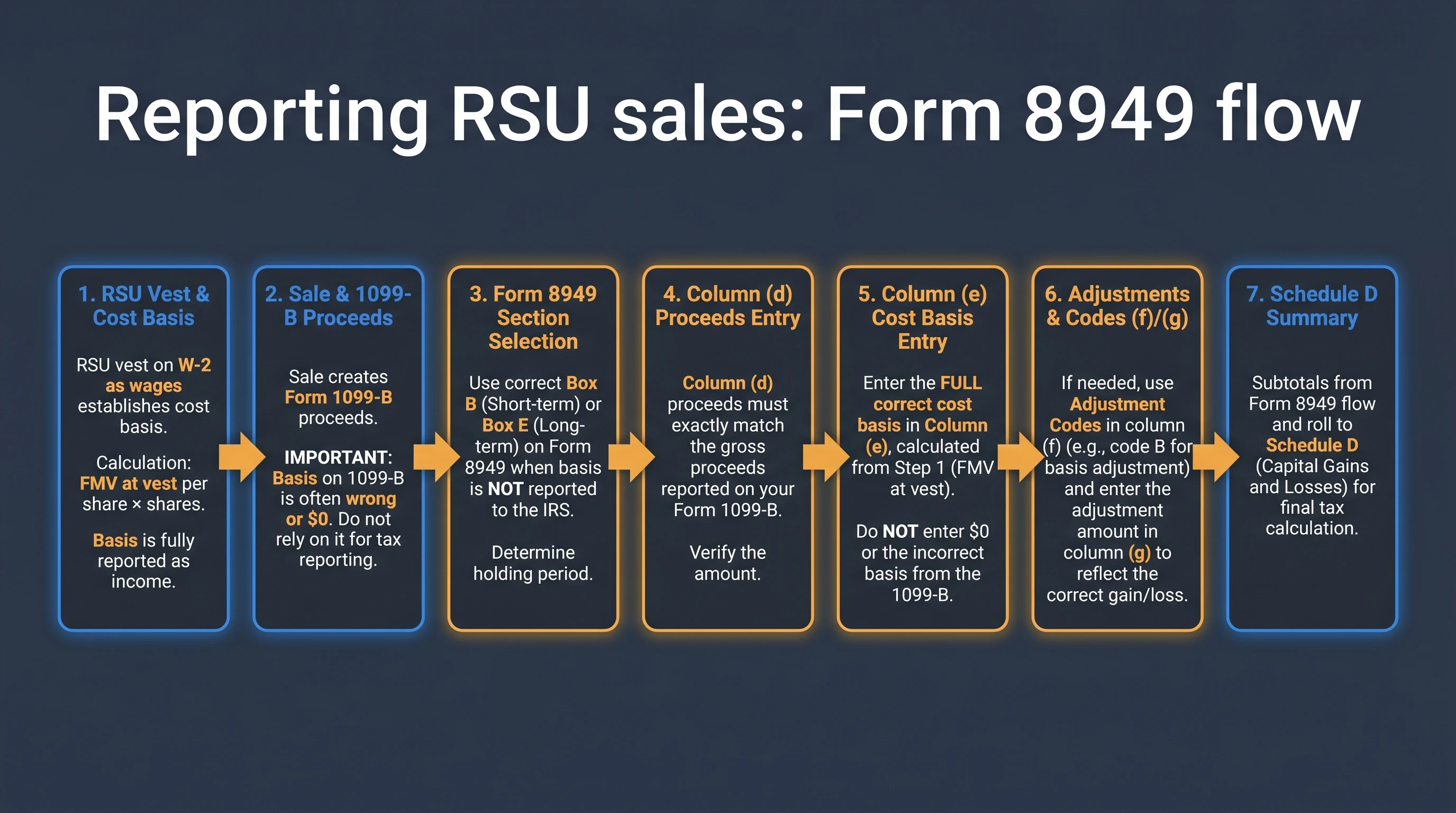
Figure 1: Publication 525 wage layer (W-2) feeds Form 8949 cost basis to correct Form 1099-B $0 reporting.
Disclaimer: This guide discusses general U.S. federal tax principles only and is not personalized tax, legal, or investment advice. Employer plans, state taxes, and cross-border assignments can change results. Confirm facts with the sources cited and a qualified tax professional.
Research note: Editorial publish 24 August 2026 for irs publication 525 restricted stock units intent—RSU cost basis on Form 8949 using Publication 525 wage rules to avoid double tax on vested share sales.
Footnotes
-
Instructions for Form 1099-B — broker reporting of cost or other basis. irs.gov/instructions/i1099b ↩